
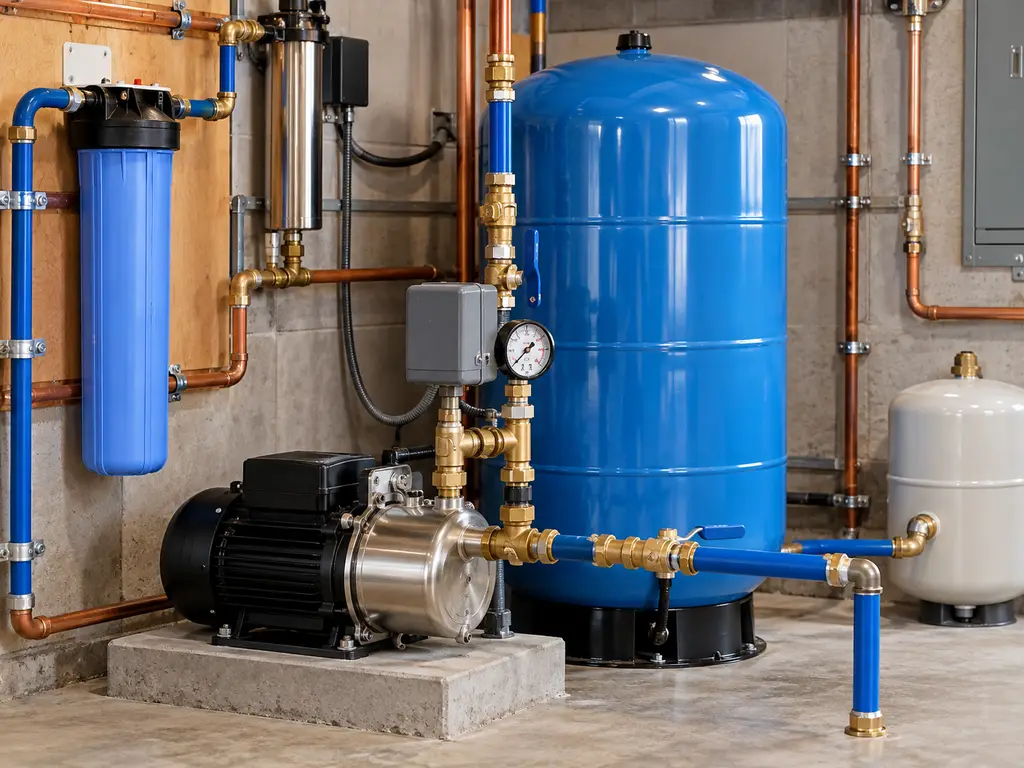
Losing all water on a private well usually comes down to a short list of causes: no power reaching the pump, a pressure switch that has stopped calling for water, a failed control box or pump motor, a frozen or broken line between the well and the house, or a water level that has dropped below the pump. The first few minutes are about ruling out the simple causes safely and protecting the pump from more damage.
If you are inside Ellensburg city limits and on city water, a no-water problem is a utility issue rather than a well pump issue. This page is for homes, farms and cabins on a private well across Ellensburg, Kittitas, Thorp, Cle Elum, South Cle Elum and Roslyn.
Safe checks before you call
- 1
Check the well pump breaker
Find the breaker labeled well or pump (usually a double-pole 240-volt breaker). If it has tripped, reset it once. If it trips again, leave it off: that points to an electrical fault in the pump, wire or control box.
- 2
Read the pressure gauge at the tank
A needle near zero means the system is not being refilled. Normal pressure at the tank with no water at the faucets points to a closed valve, a clogged filter or a frozen pipe inside the house instead.
- 3
Work out whether the pump is running
A submersible pump sits down in the well, so you usually cannot hear it. If the pump seems to run nonstop while the gauge stays low, turn it off at the breaker. Running dry can destroy a pump.
- 4
Check filters and valves
A clogged whole-house sediment filter can choke flow to a trickle. Make sure the valves near the pressure tank are open.
- 5
Think about cold and power
After a hard freeze, look for frozen pipe in the well house, pump house or where the line enters the home. After a power outage, a pressure switch with a low-pressure cutoff may need to be reset before the pump will restart.
Do not remove the pressure switch cover, open the control box or take off the well cap. Those carry live 240-volt connections, and an open well can be contaminated.
Pump running vs. pump silent: what it usually means
Pump seems to run, but no water
- •Water level has dropped below the pump intake
- •Drop pipe has split or separated in the well
- •Worn pump that turns but no longer lifts water
- •Shallow-well jet pump that has lost its prime
- •Frozen or broken line between the well and the house
Full troubleshooting guide: well pump running but no water
Pump silent, no water
- •Tripped breaker or blown fuse
- •Pressure switch failed, or tripped on low-pressure cutoff
- •Failed capacitor or relay in the control box (three-wire pumps)
- •Pump motor failure
- •Damaged wire between the house and the pump
Related: well pump repair and submersible pump repair
If water comes back but the pressure swings or the pump clicks on and off every few seconds, the pressure tank is the more likely problem.
No water in Kittitas County: local conditions worth knowing
What often triggers no-water calls here
- •Winter freezes. Subfreezing nights are routine in the Kittitas Valley, and pipe in unheated well houses, pump houses and shallow runs is usually what freezes first.
- •Wind and storm outages. The valley is known for strong wind. When power drops and returns, a breaker can trip, a low-pressure cutoff can latch off, or a surge can damage a control box.
- •Late-summer water levels. During long dry stretches and heavy garden or pasture watering, some wells draw down far enough that the pump starts pulling air.
- •Upper-county snow. Around Cle Elum, Roslyn and South Cle Elum, deep snow can bury well heads and pump houses. Clearing a path to the equipment saves time once help arrives.
Who fixes a well that has no water?
Most no-water problems are handled by a well pump contractor: the pump, pressure switch, pressure tank, control box and wiring. A well driller is needed when the well itself can no longer supply enough water. A plumber is the right call when the well system holds normal pressure but water is not reaching part of the house. In Washington, you can check a contractor's registration with the Department of Labor & Industries' Verify a Contractor tool before work starts.
During the visit, the provider will typically test voltage at the pressure switch and control box, check whether the pump is drawing current, look at water level and recovery, and then explain repair versus replacement. Older pumps with obsolete parts sometimes make replacement the better choice, while many no-water calls turn out to be a switch, capacitor or wiring fix.
What a no-water service call typically covers
✓No Water Pressure Diagnosis
Identifies whether the loss of flow stems from the pump, switch, or electrical supply before any parts are ordered.
✓Well Pump Motor Assessment
Checks motor function and wiring integrity to determine if the existing pump can be restored or needs full replacement.
✓Pressure Switch and Control Evaluation
Examines the switch, capacitor, and relay settings that commonly fail and cut off water delivery to the home.
✓Submersible Pump Retrieval Guidance
Outlines the steps and equipment needed when a pump must be pulled from the well for inspection or replacement.
How it works
- 1
Describe the Symptoms
Note exactly when water stopped, any unusual sounds, and recent weather or power events.
- 2
Review the Well System
Locate the pressure tank, control box, and well head to prepare for the provider visit.
- 3
Provider Evaluates the Cause
A local technician tests power, controls, and pump operation to pinpoint the failure.
- 4
Discuss Repair or Replacement Options
Compare costs and timelines for fixing the current issue versus installing a new pump.
What affects the cost
There is no flat price for a no-water call. The total depends on what failed (a pressure switch or capacitor is a small part; pulling a deep submersible pump is a much bigger job), the depth and type of pump, after-hours timing, and travel to rural property. See how much well pump repair costs in Central Washington for typical ranges.